
The Digital Currency Era: Financial Innovation or Tool for Control?
SPONSOR: www.AmoreZero.com
Listen here AUDIO 22 min:
The digitization of money is redefining the global financial system through the emergence of CBDCs (Central Bank Digital Currencies) and stablecoins.
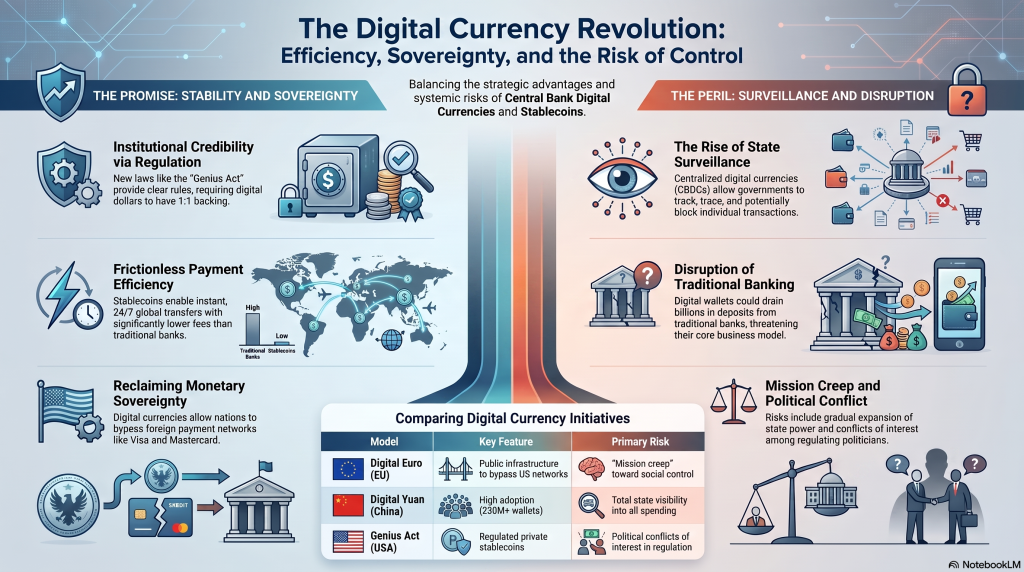
Among the positive aspects is the progressive regulation of the cryptocurrency sector, as evidenced by the approval of the “Genius Act” in the United States.
This law requires stablecoin issuers to back every digital token with a real dollar or short-term government securities. Such rules provide a solid foundation for a market previously perceived as unstable, attracting banks, consumers, and institutional investors.
Indeed, stablecoins enable instant transfers and minimal fees without relying on traditional banking networks, thereby simplifying daily payments and salary disbursements.
Furthermore, projects like “Open USD” aim to create open standards by redistributing reserve yields to those building the ecosystem.
Geopolitically, stablecoins act as a “Trojan horse” to preserve dollar hegemony across decentralized digital networks, countering the expansion of the Chinese digital yuan in developing nations.
Similarly, the digital euro is being promoted by the ECB to safeguard European monetary sovereignty, offering a public payment infrastructure independent of American giants like Visa and Mastercard.
It will complement cash, featuring offline capabilities, high levels of privacy, and a guarantee against the arbitrary freezing of funds without judicial authorization. CBDCs also aim to expedite subsidy distribution and combat fraud.
However, significant negative aspects are emerging. First, regulation is intertwined with deep political conflicts of interest, such as the case of Donald Trump and his family, who hold billions of dollars in exposure to personal crypto projects and tokens while pushing for legislation favorable to the sector.
At the level of… …banking sector, the widespread adoption of digital currencies threatens to drain significant deposits from traditional financial institutions. However, the primary concern centers on centralized surveillance.
As programmable, government-issued currencies, CBDCs theoretically enable authorities to monitor every expenditure, block transactions, or impose time limits on money to stimulate consumption—practices already piloted in China.
Although Europe initially promises constitutional safeguards, critics warn of “mission creep“* the gradual erosion of privacy and individual rights justified by emergencies or anti-money laundering regulations. Furthermore, technological centralization creates systemic vulnerabilities, such as outages in interbank settlement networks, cyberattacks, and data breaches.
Finally, a fully cashless society risks marginalizing less digitally savvy segments of the population and eliminating physical cash, which remains the ultimate guarantee of tangible, untraceable financial freedom. In the US, similar concerns have led to the passage of anti-surveillance laws and state-level bans on CBDCs, such as in Florida.

Condividi: