AmoreZero.com: Health first. Eat clean. Reconnect with nature.
Listen here:
[SPONSORED CONTENT — Press release provided by AmoreZero.com]
Introduction: Why Food Structure Matters Beyond the Nutrition Label
AmoreZero is a soft nougat-inspired snack made primarily with roasted whole almonds and raw honey. It was developed around a principle increasingly recognized in nutrition science: the same nutrient can produce different metabolic responses depending on the food structure it is consumed with.
Nutrition labels describe quantities of nutrients. Metabolic responses, however, also depend on how those nutrients are physically embedded within a food — its texture, cellular structure, and how it slows or accelerates digestion. This is the foundation of food matrix science.
A snack with 5g of refined sugar, one with 5g of glucose syrup, and one with 5g of honey embedded in a dense almond-based matrix may all carry the same “Includes 5g Added Sugars” declaration. Yet the speed at which those sugars enter the bloodstream, and the corresponding insulin response, may differ. The degree to which AmoreZero produces a meaningfully different glycemic response as a finished product has not yet been validated by independent clinical testing specific to this product. The scientific rationale described below is based on published evidence regarding the individual ingredients and established food matrix principles.

Why the Sugar Source Matters: Honey Is Not Refined Sugar
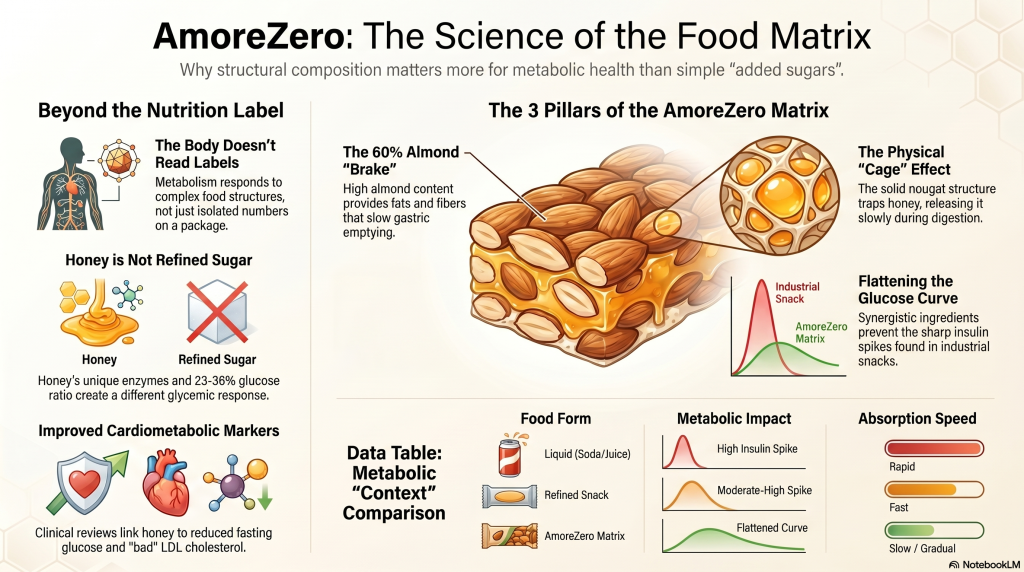
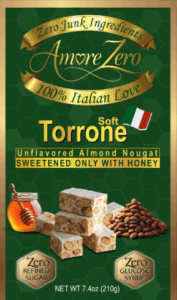
AmoreZero uses raw honey as its only sweetener, replacing refined sugar, glucose syrups, and corn syrups. The sugar profile of honey differs from refined sweeteners: it is composed primarily of fructose (approximately 40%) and glucose (23–36%, depending on botanical origin), alongside water, organic acids, enzymes, amino acids, phenolic compounds, flavonoids, minerals, and rare sugars. This natural composition offers a different metabolic profile than isolated sucrose or glucose.
 A systematic review published in Nutrition Reviews (2023) found honey associated, on average across multiple clinical studies, with reductions in fasting blood glucose, total cholesterol, LDL, triglycerides, and liver enzyme ALT, while increasing HDL. These findings reflect pooled analyses of studies on honey as an isolated ingredient, not on honey embedded in a specific food product like AmoreZero. This does not mean honey can be consumed without limits, and it does not mean AmoreZero has been clinically tested.
Note: Although FDA nutrition labeling requires that honey added to a processed product be declared as “Added Sugars,” this reflects the regulatory category, not the metabolic behavior of the ingredient. The distinction between the label and the biological response is precisely what food matrix science examines.
The AmoreZero Who Created It
 An Italian family relocated to the United States — motivated by their daughter’s academic and professional opportunities — and observed two converging realities: approximately 1 in 5 US children is affected by obesity (a rate that has tripled over three decades), and the mainstream snack market is dominated by ultra-processed products with refined sugars and artificial ingredients.
Rather than proposing AmoreZero as a mass-market solution to childhood obesity — a claim it cannot support — the founders set out to offer a premium alternative demonstrating that traditional Italian confectionery can be reformulated with higher nutritional intentionality. They revisited a traditional Italian nougat recipe and replaced refined sugar with raw honey. Initial informal observations among friends and family suggested a different experience compared to conventional sweets. These observations motivated a formal study of food matrix science and 16 months of product development in an artisanal laboratory in Italy.
AmoreZero is a premium snack for consumers who want to make more informed choices. It is not a medical food, a therapeutic product, or a treatment for any condition.
The Food Matrix: What It Is and Why It Matters
The food matrix describes the physical and chemical architecture of a food: how nutrients are interconnected, trapped in cellular structures, and released during digestion. Blood glucose levels one to two hours after eating depend not only on the sugar content of a food, but on its overall structure, gastric emptying rate, and the speed at which sugars are absorbed.
A landmark study published in The Lancet demonstrated that whole apples, applesauce, and apple juice — identical in sugar content and origin — produce dramatically different glucose and insulin responses. The study illustrates the food matrix principle: physical structure influences metabolic outcome. AmoreZero applies this principle to its formulation, though the specific effect of its matrix has not been tested in a controlled clinical study on the finished product.
Four Scientific Design Principles
 AmoreZero‘s formulation is based on four nutritional design principles derived from the published literature on its ingredients. These are design rationales, not clinical claims about the finished product.
1. Raw honey instead of refined sugars
Replacing refined sugar, glucose syrups, and corn syrups with raw honey may contribute to a different glycemic response, depending on the overall food matrix context and individual variation. (Source: Nutrition Reviews, 2023 — study on honey as isolated ingredient.)
2. Roasted whole almonds (60%+ of formulation)
Research on almonds shows they generally lower the glycemic index of a meal, reduce postprandial insulin concentrations, decrease oxidative stress markers, and increase satiety. Each serving contains approximately 10g of whole roasted almonds. (Sources: multiple studies in European Journal of Clinical Nutrition and The Journal of Nutrition — studies on almonds as isolated ingredient.)
3. Fat, protein, and fiber
The combination of fats, protein, and fiber in the formulation generally slows digestion and gastric emptying, which can reduce glucose, insulin, and incretin hormone spikes compared to refined carbohydrate-only snacks. (Source: established nutritional literature on macronutrient co-ingestion.)
4. Physical structure of the nougat
AmoreZero‘s compact, chewy physical structure may act as a slow-release matrix, reducing the rate at which honey’s sugars are exposed to digestive enzymes. This is consistent with the food microstructure principles demonstrated in the Lancet apple study referenced above.
Together, these four factors are designed to create a metabolic environment different from conventional snacks with refined sugars. The combined effect of this specific formulation on glycemic response has not yet been tested in a controlled clinical study on AmoreZero as a finished product. The company aims to validate this specific food matrix effect through future independent glycemic index testing.
About the Founders
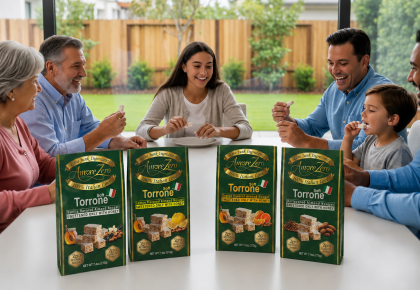
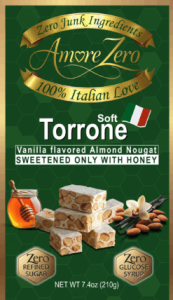
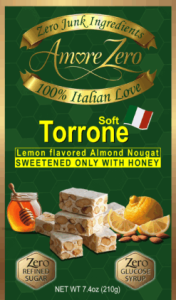
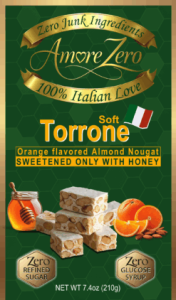
 AmoreZero was created by an Italian family who brought with them a deep knowledge of traditional Italian confectionery — including a nougat recipe with roots in 17th-century Italian pastry tradition. After relocating to the United States, they applied modern food matrix science to that historical recipe, replacing refined sugar with raw honey and optimizing the formulation over 16 months of development in an artisanal laboratory in Italy. The result is a snack available in four varieties: Natural, Vanilla, Orange, and Lemon.
Where to Find AmoreZero
AmoreZero is available direct-to-consumer across the United States at AmoreZero.com — no distributors, no retail chains.
The product is also available in person at Nourish & Nosh Bakery Bistro, downtown Clearwater, Florida, which serves as a local pilot and demonstration point for the brand’s innovation approach.
To learn more, read the full scientific background, or place an order: AmoreZero.com
LEGAL DISCLAIMER
This article is for educational and informational purposes only. It does not constitute medical advice. AmoreZero is a food product and is not intended to diagnose, treat, cure, or prevent any disease or medical condition. Consult a qualified healthcare provider before making any changes to your diet, particularly if you have diabetes, insulin resistance, or any metabolic condition. Individual responses to food vary. Added sugars, including honey, should be consumed in moderation as part of a balanced diet.
The scientific references cited describe studies on individual ingredients (honey, almonds) under controlled conditions. No clinical study has been conducted on AmoreZero as a finished product. Results from ingredient-level studies do not guarantee equivalent outcomes from the finished product.
References
[1] Ahmed A et al. “Effect of honey on cardiometabolic risk factors: a systematic review and meta-analysis.” Nutrition Reviews. 2023. Oxford Academic
[2] Samanta A, Burden AC, Jones GR. “Plasma glucose responses to glucose, sucrose, and honey in patients with diabetes mellitus: an analysis of glycaemic and peak incremental indices.” Diabetic Medicine. 1985. PubMed
[3] Deibert P et al. “Glycaemic and insulinaemic properties of some German honey varieties.” European Journal of Clinical Nutrition. 2010. PubMed
[4] Shkembi B, Huppertz T. “Glycemic Responses of Milk and Plant-Based Drinks: Food Matrix Effects.” Foods. 2023. MDPI
[5] Josse AR et al. “Almonds and postprandial glycemia—a dose-response study.” Metabolism. 2007. PubMed
[6] Jenkins DJA et al. “Almonds decrease postprandial glycemia, insulinemia, and oxidative damage in healthy individuals.” The Journal of Nutrition. 2006. PubMed
[7] Mori AM et al. “Acute and second-meal effects of almond form in impaired glucose tolerant adults: a randomized crossover trial.” Nutrition & Metabolism. 2011. BMC
[8] Giuntini EB et al. “The Effects of Soluble Dietary Fibers on Glycemic Response: An Overview and Futures Perspectives.” Foods. 2022. PMC
[9] Harvard T.H. Chan School of Public Health. “Carbohydrates and Blood Sugar.” Harvard Nutrition Source
[10] Murillo S et al. “Culinary strategies to manage glycemic response in people with type 2 diabetes: A narrative review.” Frontiers in Nutrition. 2022. PMC
[11] Gentilcore D et al. “Effects of fat on gastric emptying of and the glycemic, insulin, and incretin responses to a carbohydrate meal in type 2 diabetes.” Journal of Clinical Endocrinology & Metabolism. 2006. PubMed
[12] Marathe CS et al. “Relationships between gastric emptying, postprandial glycemia, and incretin hormones.” Diabetes Care. 2013. PMC
[13] Rossano R et al. “What Are the Proteolytic Enzymes of Honey and What They Do Tell Us? A Fingerprint Analysis by 2-D Zymography of Unifloral Honeys.” PLOS ONE. 2012. PMC
[14] U.S. Food & Drug Administration. “Added Sugars on the Nutrition Facts Label.” FDA
[15] Haber GB, Heaton KW, Murphy D, Burroughs LF. “Depletion and disruption of dietary fibre. Effects on satiety, plasma-glucose, and serum-insulin.” The Lancet. 1977;2(8040):679–682. PubMed
Disclaimer: The information provided in this article is for educational purposes only and should not be considered medical advice. Individuals with diabetes or other metabolic conditions should consult their healthcare provider before making dietary changes.