
AmoreZero: The Evolution of Snacking Starts in Florida
Souce: https://www.amorezero.com/
Listen here:
Introduction: Looking Beyond the Nutrition Label
When we read a nutrition label, our attention is often drawn to a specific item: added sugars. We use this number to estimate how a food might affect our blood sugar levels.
The U.S. FDA groups many different sweeteners under the same category, including white sugar, cane sugar, sucrose, glucose, dextrose, fructose, industrial syrups, and honey.
But what if the exact same 5 grams of sugar could behave differently inside the human body depending on the food it is consumed with?
This is not a marketing claim. It is the foundation of food matrix science and the central question behind the AmoreZero project.
The key point is simple: the human body does not read nutrition labels—it digests food.
A snack containing 5 grams of refined sugar, one containing 5 grams of glucose, and one sweetened with honey may all display the same statement: “Includes 5g Added Sugars.” Yet biologically and metabolically, these sugars are not identical.
The body processes them through different metabolic pathways, producing different insulin responses.
Pure glucose, for example, enters the bloodstream rapidly, causing a sharp increase in blood sugar and requiring the pancreas to release insulin quickly to compensate.
Why the Source Matters: Honey Is Not Refined Sugar
The first step in understanding this difference is examining the source of the sugar.
AmoreZero uses honey, a complex natural substance produced by bees from flower nectar. During honey production, enzymes released by the bees transform the original sugars.
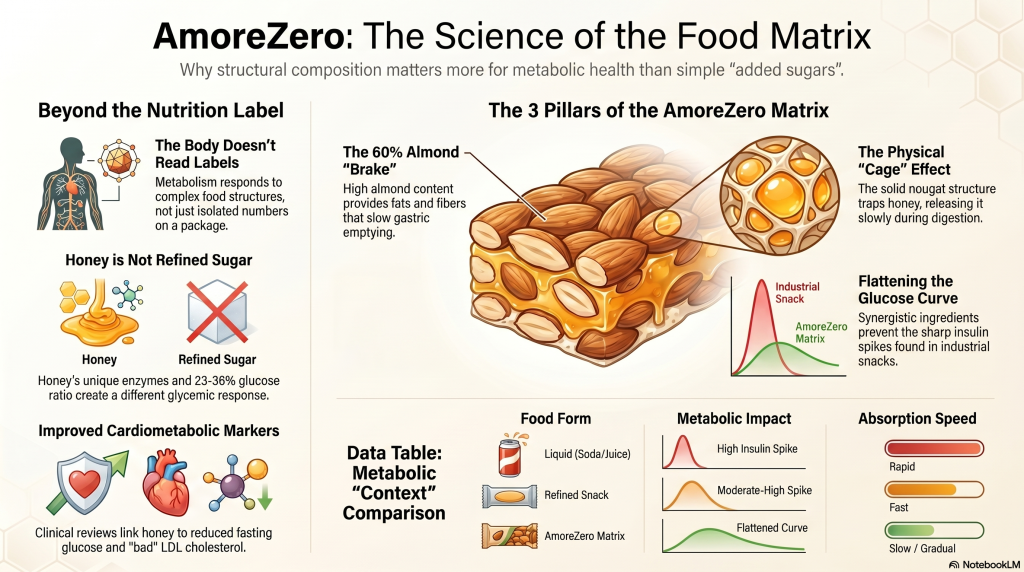
As a result, honey has a unique chemical profile. Glucose typically represents only 23% to 36% of its total sugar content. The remainder consists of water, fructose, organic acids, enzymes, amino acids, phenolic compounds, flavonoids, minerals, and rare sugars.
These chemical differences translate into physiological differences.
Several clinical studies suggest that honey may produce metabolic responses different from those generated by glucose or sucrose.
A systematic review and meta-analysis published in Nutrition Reviews reported that honey consumption was associated with reductions in fasting blood glucose, total cholesterol, LDL (“bad”) cholesterol, triglycerides, and liver enzyme ALT, while simultaneously increasing HDL (“good”) cholesterol.
This does not mean honey has no effect on blood sugar or can be consumed without limits. It simply demonstrates that the statement “all sugar is the same” is an oversimplification.
The real question is not simply how many grams of sugar a product contains, but what type of sugar it actually contains.
Understanding the Food Matrix
If AmoreZero consisted only of honey, the discussion would end there.
However, AmoreZero is a soft nougat-inspired snack available in flavors such as Natural, Vanilla, Orange, and Lemon. It is made primarily with roasted whole almonds.
Each serving contains approximately 10 grams of almonds and 5 grams of sugars derived from honey, along with meaningful amounts of fats, protein, and fiber.
This is where the concept of the food matrix becomes important.
Food is not merely a list of nutrients. The food matrix describes the physical and chemical architecture of a food: how nutrients are interconnected, trapped within cellular structures, and ultimately released, digested, and absorbed.
Blood glucose levels one to two hours after eating are influenced not only by the amount of carbohydrates consumed, but also by food structure, gastric emptying time, and the speed at which sugars enter the bloodstream.
The Four Scientific Pillars of AmoreZero
1. Honey as the Preferred Sweetener
By avoiding refined sugars, glucose syrups, and corn syrups, and using honey as the exclusive sweetener, AmoreZero may produce a different glycemic response than conventional snacks.
2. The Metabolic Impact of Almonds
Almonds represent more than 60% of the product’s formulation.
Research has shown that adding almonds to a meal can lower the overall glycemic index, reduce insulin concentrations, decrease oxidative stress, and increase satiety while helping maintain more stable blood sugar levels.
Consuming honey within a meal rich in almonds may therefore create a more favorable physiological response than consuming honey by itself.
3. The Moderating Effect of Fat, Protein, and Fiber
The shape of the blood sugar curve depends largely on digestion speed.
Fat and fiber act as natural brakes, slowing digestion and intestinal absorption, helping create a more gradual rise in blood glucose.
Research has extensively documented that dietary fat can significantly delay gastric emptying, reducing spikes in glucose, insulin, and incretin hormones such as GIP.
4. The Physical Structure of the Nougat
This may be the most fascinating aspect.
AmoreZero is not a beverage or a liquid syrup. It has a compact, chewy structure that acts as a natural cage, embedding honey within almonds, healthy fats, and structural proteins.
A landmark study published in The Lancet compared metabolic responses to whole apples, applesauce, and apple juice. Despite originating from the same fruit, each form produced dramatically different glucose and insulin responses due to differences in the integrity of the fiber matrix.
Similarly, honey embedded within the solid structure of AmoreZero may be released and absorbed more gradually.
Beyond Marketing: The Science of Nutrition
Understanding these mechanisms helps explain why nutrition labels, while useful for tracking calories and macronutrients, have important limitations.
A nutrition label cannot describe the three-dimensional architecture of a food. It cannot tell us whether sugar is freely dissolved in a beverage or firmly embedded within a dense matrix of almonds and fiber.
The four factors discussed above may create a metabolic environment different from that produced by conventional snacks made with refined sugars and industrial syrups.
Ingredient quality, careful processing, and thoughtful formulation can influence how the body responds to food.
At first glance, the idea that the same amount of sugar can produce different effects in the body may seem surprising. Yet the explanation is neither mysterious nor magical.
It is simply nutrition science.
Who Created AmoreZero?
The story behind AmoreZero begins with an Italian family who moved to the United States at age 45 to provide their daughter with the opportunities of the American Dream.
Committed to a healthy lifestyle and natural foods, they quickly noticed two realities that deeply concerned them.
On one side, childhood obesity in the United States had reached alarming levels, affecting approximately one in five children and tripling over the last three decades.
On the other side, the snack market was dominated by ultra-processed products rich in refined sugars, industrial syrups, and ingredients far removed from traditional food culture.
This personal need inspired a different solution.
The family revisited a traditional Italian nougat recipe dating back to the 1600s and adapted it to modern nutritional principles.
Refined sugar was removed and replaced with raw honey while preserving simple, recognizable ingredients.
When friends living with diabetes tried the product that would later become AmoreZero Snack, many reported noticeably lower blood sugar and insulin responses compared with traditional snacks.
These observations motivated the founders to explore the scientific literature in search of an explanation.
Their research led them to investigate the concept of the food matrix created by the combination of honey and almonds, a structure that may influence how the body absorbs and metabolizes sugars.
How Long Has AmoreZero Been in Development?
The product required 16 months of development in an artisanal laboratory in Italy before achieving the desired result.
Today, AmoreZero is available directly through AmoreZero.com and at Nourish & Nosh Bakery Bistro in downtown Clearwater, Florida.
There are currently no distributors or retail chains involved.
The product is sold directly to consumers throughout the United States.
Florida represents an ideal environment for food innovation. With a population increasingly focused on wellness, natural ingredients, and prevention, it provides the perfect setting where Italian tradition can meet modern nutritional needs.
The question is not whether a snack contains sugar.
The question is: What food are we actually eating?
Understanding the differences among ingredients, processing methods, and food matrices can help consumers make more informed choices every day.
References
[1] Ahmed A et al. “Effect of honey on cardiometabolic risk factors: a systematic review and meta-analysis.” Nutrition Reviews. 2023. Oxford Academic
[2] Samanta A, Burden AC, Jones GR. “Plasma glucose responses to glucose, sucrose, and honey in patients with diabetes mellitus: an analysis of glycaemic and peak incremental indices.” Diabetic Medicine. 1985. PubMed
[3] Deibert P et al. “Glycaemic and insulinaemic properties of some German honey varieties.” European Journal of Clinical Nutrition. 2010. PubMed
[4] Shkembi B, Huppertz T. “Glycemic Responses of Milk and Plant-Based Drinks: Food Matrix Effects.” Foods. 2023. MDPI
[5] Josse AR et al. “Almonds and postprandial glycemia—a dose-response study.” Metabolism. 2007. PubMed
[6] Jenkins DJA et al. “Almonds decrease postprandial glycemia, insulinemia, and oxidative damage in healthy individuals.” The Journal of Nutrition. 2006. PubMed
[7] Mori AM et al. “Acute and second-meal effects of almond form in impaired glucose tolerant adults: a randomized crossover trial.” Nutrition & Metabolism. 2011. BMC
[8] Giuntini EB et al. “The Effects of Soluble Dietary Fibers on Glycemic Response: An Overview and Futures Perspectives.” Foods. 2022. PMC
[9] Harvard T.H. Chan School of Public Health. “Carbohydrates and Blood Sugar.” Harvard Nutrition Source
[10] Murillo S et al. “Culinary strategies to manage glycemic response in people with type 2 diabetes: A narrative review.” Frontiers in Nutrition. 2022. PMC
[11] Gentilcore D et al. “Effects of fat on gastric emptying of and the glycemic, insulin, and incretin responses to a carbohydrate meal in type 2 diabetes.” Journal of Clinical Endocrinology & Metabolism. 2006. PubMed
[12] Marathe CS et al. “Relationships between gastric emptying, postprandial glycemia, and incretin hormones.” Diabetes Care. 2013. PMC
[13] Rossano R et al. “What Are the Proteolytic Enzymes of Honey and What They Do Tell Us? A Fingerprint Analysis by 2-D Zymography of Unifloral Honeys.” PLOS ONE. 2012. PMC
[14] U.S. Food & Drug Administration. “Added Sugars on the Nutrition Facts Label.” FDA
[15] Haber GB, Heaton KW, Murphy D, Burroughs LF. “Depletion and disruption of dietary fibre. Effects on satiety, plasma-glucose, and serum-insulin.” The Lancet. 1977;2(8040):679–682. PubMed
Disclaimer: The information provided in this article is for educational purposes only and should not be considered medical advice. Individuals with diabetes or other metabolic conditions should consult their healthcare provider before making dietary changes.


