
AmoreZero: The Science of the Food Matrix
Souce: https://www.amorezero.com/amorezero-magic-or-science/
Listen here:
AmoreZero:
The Science of the Food Matrix
Introduction: Beyond the Label Numbers When we read a nutrition label, our eyes naturally gravitate toward “added sugars” to gauge how a snack might impact our blood sugar. The FDA classifies diverse sweeteners—such as white or cane sugar, sucrose, glucose, dextrose, fructose, syrups, and honey—under this single category.
However, what if the exact same 5 grams of sugar could behave completely differently in our bodies depending on what it is mixed with?.
This is not a marketing gimmick; it is the foundation of food matrix science, and the core philosophy behind AmoreZero.
The crucial point is that the human body does not read labels; it digests food. A snack containing 5g of refined sugar, one with 5g of glucose, and another sweetened with honey might all look identical on a nutrition label, but from a biological and metabolic standpoint, they are completely distinct. Our bodies break down these sugars through different metabolic pathways, triggering varying levels of insulin. Pure glucose, for example, enters the bloodstream directly, causing a sharp spike in blood sugar and forcing the pancreas to release a rapid surge of insulin.
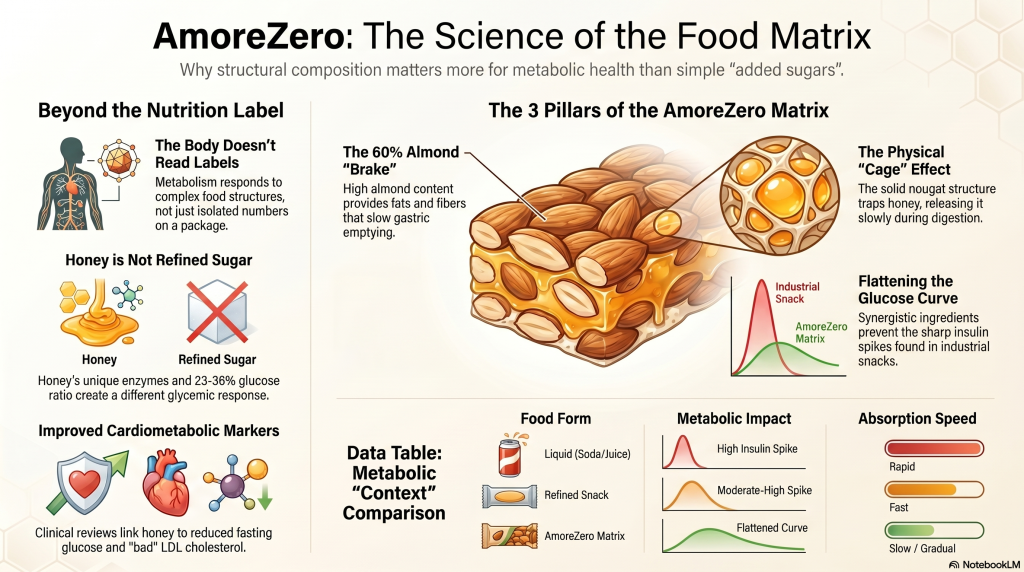
The Source Matters: Honey is Not Refined Sugar The first key distinction is the origin of the sweetener. AmoreZero uses honey, a complex natural substance produced by bees from floral nectar. Thanks to the bees’ enzymes, the original sugars are transformed, giving honey a unique chemical profile. Glucose typically makes up only 23-36% of its total sugars. The remainder is a rich blend of water, fructose, organic acids, enzymes, amino acids, phenolic compounds, flavonoids, minerals, and rare sugars.
These chemical differences translate into tangible physiological effects. Clinical research indicates that honey generates different metabolic responses compared to sucrose or glucose. A systematic review and meta-analysis published in Nutrition Reviews found that honey consumption is associated with decreased fasting blood glucose, total cholesterol, LDL (“bad”) cholesterol, and triglycerides, alongside an increase in “good” HDL cholesterol.
This does not mean honey never affects blood sugar or can be consumed boundlessly, but it scientifically proves that claiming “all sugar is the same” is a dangerous oversimplification. The better question isn’t just how many grams of sugar are listed, but what type of sugar it actually is.
The Power of the “Food Matrix” If AmoreZero were made entirely of honey, the metabolic benefits would stop there. But AmoreZero is a soft, chewy nougat crafted primarily from whole roasted almonds. A single serving provides about 10g of almonds alongside 5g of honey-derived sugars, packed with essential fats, plant-based proteins, and fiber.
This is where the food matrix becomes vital. Food is never just a math equation of isolated macronutrients. The “food matrix” refers to a food’s physical and chemical architecture: how its nutrients are arranged, structurally trapped, released, digested, and absorbed. Post-meal blood glucose levels depend not only on carbohydrate volume but also on the food’s complex structure, the rate of gastric emptying, and how fast monosaccharides enter the bloodstream.
The Four Scientific Pillars of AmoreZero The reason AmoreZero acts differently than highly processed snacks relies on a specific synergy of four distinct factors:
- Honey as the Sweetener: By utilizing honey instead of refined sugars or glucose syrups, the product naturally sets the stage for a different baseline glycemic response.
- The Metabolic Impact of Almonds: Almonds make up over 60% of AmoreZero’s formulation. Authoritative studies demonstrate that adding almonds to a meal progressively lowers its overall glycemic index, reduces insulin levels, and mitigates oxidative damage. Furthermore, almonds enhance a prolonged sense of satiety while actively lowering blood glucose concentrations. Consequently, consuming honey within an almond-rich meal produces a much more favorable physiological response than consuming the honey on its own.
- The Braking Effect of Fats, Proteins, and Fiber: Your blood sugar curve is tied directly to the speed of digestion. Fats and fiber act as a natural brake, slowing down gastric emptying and intestinal absorption. This prevents sugars from rapidly flooding the bloodstream, resulting in a flatter, more gradual blood sugar curve. Research confirms that meals containing fat significantly delay gastric emptying, which powerfully attenuates post-meal spikes in glucose, insulin, and incretin hormones (like GIP)—a dynamic that is crucial even for managing glycemia in people with type 2 diabetes.
- The Physical Structure of Nougat: This is perhaps the most fascinating element. AmoreZero is not a liquid syrup or a beverage. It is a solid, compact, and chewy nougat that serves as a natural “cage,” physically trapping the honey and intimately mixing it with almonds, lipids, and structural plant proteins. Similar to how historical studies published in The Lancet show that whole apples, applesauce, and apple juice produce dramatically different glucose and insulin curves due to the integrity of the fibrous matrix, the honey in AmoreZero is released differently. It demands longer chewing and prolongs both gastric processing and intestinal absorption.
Conclusion: Nutritional Science, Not Marketing Understanding these mechanisms highlights why traditional nutrition facts labels are inherently limited. While necessary for tracking calories and macronutrients, a label cannot map the three-dimensional structure of a food. It cannot tell you if a sugar is freely dissolved in a soda or firmly anchored within a compact matrix of almonds, fats, and fiber.
Together, these four factors establish a metabolic context for AmoreZero that is radically different from traditional snacks laden with refined sugars and industrial syrups. At first glance, the idea that the exact same amount of sugar could behave so differently in your body might seem like “magic”. Yet, the reason is not mysterious: it isn’t magic, it’s the science of food.


